
A Display Energy Certificates is an official document that shows the real, measured energy performance of a public building. It is based on actual meter readings collected over the previous twelve months, not a theoretical model or a prediction from when the building was designed. The certificate must be placed somewhere clearly visible so that every person walking into the building can see it without having to go looking for it.
The goal is public accountability. When someone walks into a hospital, a school, or a government office, they have the right to know how efficiently that building is being run in terms of energy. Ireland introduced the mandatory DEC requirement as part of its implementation of the European Union’s Energy Performance of Buildings Directive, which all EU member states were required to bring into law by January 2009. Ireland’s Climate Action Plan has since strengthened the role of DECs as a practical tool for driving carbon emissions reduction across the public sector.
At BES Consultants, we are SEAI registered energy assessors carrying out DEC assessments for schools, hospitals, government offices, and other public buildings across Ireland. This guide covers everything a building owner or facilities manager needs to know.
What Display Energy Certificates Actually Show
Think of a DEC the way you think of a nutrition label on a food product. It does not tell you what the product was designed to be. It tells you what it actually is right now. A building might have been constructed to a high specification with excellent insulation and efficient systems, but if it is being operated wastefully, the certificate will reflect that reality honestly. Equally, an older building with outdated fabric can still achieve a decent rating if it is managed well through strong day to day energy management.
The certificate shows the building’s energy rating for the current year and for the two previous years. That three-year comparison is one of the most valuable parts of the document. A facilities manager can look at the certificate on the wall and immediately see whether performance is improving, holding steady, or getting worse year on year. This makes it a practical energy monitoring tool as much as a compliance document.
DEC versus BER: Understanding the Key Difference
People frequently confuse a DEC with a Building Energy Rating (BER) certificate. They are related documents but they measure completely different things and serve different purposes.
A BER is a calculated, theoretical figure. It tells you how much energy a building would use under standardised conditions based on its physical design, including insulation levels, glazing, heating system type, and building services. It is produced using SEAI approved computer modelling software and is most commonly required when a building is sold or rented. It only covers regulated energy, meaning energy used for heating, cooling, ventilation, hot water, and fixed lighting.
A DEC takes the opposite approach. It measures what actually happened over the past year. It takes real meter readings and compares them against a benchmark for buildings of the same type. The result is an operational rating that reflects what is genuinely going on in practice, not what the design assumed would happen. Unlike the BER, a DEC captures both regulated and unregulated energy, giving a complete picture of total energy use across the building.
A newly renovated school might hold a strong BER on paper. But if the heating runs through the summer holidays and classrooms stay lit over weekends, the DEC will tell a very different story. That honest, real world measurement based on actual consumption data is precisely why the DEC was introduced as a separate legal requirement from the BER.
Who Needs a DEC in Ireland
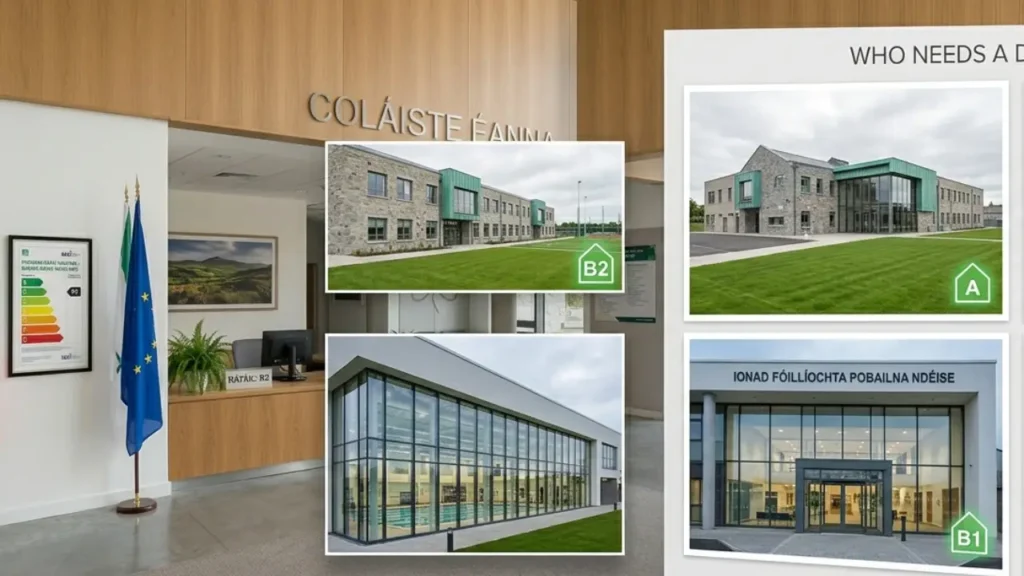
Not every building in Ireland requires one. The legal obligation applies when all four of the following conditions are met at the same time.
The building must be occupied by a public authority or public institution. Members of the general public must visit the building regularly and frequently, not just occasionally or by invitation. The building must be providing a public service to those visitors. And the total useful floor area must exceed 250 square metres, measured to the internal face of the external walls and including all enclosed spaces such as corridors, staircases, and galleries.
Buildings that typically fall within the requirement in Ireland include state funded schools and universities, public hospitals and HSE healthcare centres, public libraries, museums and art galleries run by public authorities, publicly operated leisure centres, Garda stations, prisons, courts, local authority offices open to the public, and large post offices serving members of the public.
Private equivalents are excluded. A private hospital admitting no HSE patients does not need one. A private school does not need one. A private health club does not need one. The defining test is always whether members of the public visit the building frequently for a service provided by a public body.
One important nuance worth understanding is that the requirement is not triggered simply because the building is publicly owned. A government owned data centre accessed only by staff and contractors does not meet the frequently visited by the public criterion, so no DEC is required even though public money funds the organisation.
How the A to G Rating Works
The rating scale runs from A to G, where A represents excellent energy performance and G represents very poor performance. This is the same scale Irish people are already familiar with from BER certificates and household appliance energy labels.
The rating is not based on raw kilowatt hour consumption alone. It uses an Operational Rating, which compares the building’s actual energy consumption against what a typical building of the same type, size, and use pattern would be expected to consume over the same period. A score of 100 means the building used exactly the typical amount of energy for its category. A score of 50 means it used half the typical amount, earning a B rating. A score above 150 places the building in the G band.
This benchmark relative approach makes the rating fair across different building types. A hospital running around the clock is not unfairly penalised simply because it consumes more energy in absolute terms than a part-time community library of the same floor area. The benchmark for each building use category already accounts for the expected operational intensity of that type of facility.
Reference values and current legal standards appear alongside the Operational Rating on the certificate, giving occupiers a clear picture of where they stand relative to both the benchmark and the regulatory expectation.

How the Calculation Works
Only a SEAI registered DEC assessor can produce a DEC in Ireland. Self-certification is not permitted and you cannot use a general energy consultant who does not hold specific DEC accreditation from SEAI.
The methodology is set by the SEAI and documented in the Public Buildings Technical Manual, last updated in June 2023. The SEAI’s web-based DEC calculator is only accessible to registered assessors and cannot be used by building owners or managers directly.
The starting point is twelve months of actual energy consumption data covering all fuel types used in the building. This includes natural gas, oil, solid fuels, district heating and cooling, grid electricity, and any electricity generated on-site or brought in through private distribution systems. For district heating and on-site generation, the assessor also needs the average carbon factor for the service, expressed in kilograms of carbon dioxide per kilowatt hour delivered.
Where twelve months of accurate meter readings are not available, an estimate from the energy supplier can be used. This is a recognised option under the rules for buildings where metering has not been consistently maintained.
The assessor must also carry out a physical site visit. The certificate cannot be produced from paperwork alone. The assessor needs to inspect the building’s heating systems, cooling systems, ventilation, lighting, building fabric, and occupancy patterns before the calculation is completed.
Benchmarks and Adjustments
The system uses building use category benchmarks to ensure the Operational Rating fairly reflects performance in context. Adjustments are permitted where the building covers more than one use category, where there is a meaningful climate difference between the building’s location and the national standard benchmark, where the building operates significantly longer hours than the standard benchmark assumes, or where specific energy intensive processes mean consumption is naturally higher than typical for that category. These provisions ensure the rating reflects genuine management performance rather than penalising buildings with unusual but entirely legitimate operational demands.
The Advisory Report
Every DEC must be accompanied by an Advisory Report. This document is not displayed publicly. You do not put it on the wall alongside the certificate. But you must hold a valid copy on the premises and produce it within seven days if an enforcement officer requests it.
The Advisory Report is where the practical value of the whole process really shows. It contains three layers of recommendations tailored to the specific building.
The first covers zero and low-cost operational improvements. These are changes that need little or no capital spending, such as adjusting heating schedules to match actual occupancy, setting up a regular energy monitoring routine, installing motion sensors in low-traffic areas, or training staff in proper end-of-day shutdown procedures. Many buildings achieve a meaningful improvement in their next annual rating simply by addressing wasteful habits that have built up over years without anyone questioning them.
The second covers upgrades to building fabric and services. These are more substantial investments such as better insulation, more efficient heating systems, LED lighting throughout, and improved building management controls. They cost money but deliver permanent reductions in consumption with a clear payback period through lower energy bills.
The third covers Low and Zero Carbon technologies. This is where the assessor considers opportunities for solar photovoltaic panels, heat pumps, biomass heating, and other renewable energy options. Ireland’s Climate Action Plan targets and the SEAI’s Public Sector Energy Programme make this section increasingly relevant for public buildings looking to meaningfully reduce their carbon footprint.
The Advisory Report is valid for seven years. For larger buildings renewing their DEC annually, this means a new Advisory Report is not needed with every renewal until the seven year period expires.
How Long the Certificate Remains Valid
The renewal period depends on the size of the building.
For buildings with a total useful floor area exceeding 1,000 square metres, the DEC must be renewed every twelve months. Annual renewal reflects the purpose of the certificate. A document based on consumption data from three years ago would not give the public an accurate picture of current performance.
For buildings between 250 and 1,000 square metres, the certificate needs to be renewed every ten years. The Advisory Report for these buildings still carries a seven year validity and must be replaced at that point even if the certificate itself is still within its ten year window.
How to Get a DEC in Ireland
The first step is engaging a SEAI registered DEC assessor. The SEAI BER register lists all assessors accredited to carry out DEC assessments for public buildings in Ireland. Always confirm the assessor holds current accreditation specifically for DEC work rather than only for domestic BER assessments. BES Consultants is SEAI registered and carries out assessments for public buildings across Ireland. You can contact our team.
Before the assessor visits, gather twelve months of energy consumption data for the building. Collect meter readings or supplier invoices for every fuel type used. Accurate and complete data at this stage produces a more reliable certificate and saves time during the assessment itself.
The assessor then carries out the site visit, analyses the consumption data using the SEAI approved calculator, and produces both the certificate and the accompanying Advisory Report.
Once issued, the certificate must be placed in a prominent location clearly visible to every member of the public entering the building. The Advisory Report is retained on the premises and produced on request within seven days.
Campus and Grouped Buildings
Many public sector organisations in Ireland occupy campuses with multiple buildings. University campuses, hospital groups, and large local authority estates are familiar examples where the standard building-by-building approach needs to be adapted.
For buildings on a shared campus, energy metering can be collected at site level rather than measuring each building individually. There is a key condition though. If a group of smaller buildings are physically linked by a heated space, or if they share the same heating or cooling system, a DEC is still required for that linked cluster even where each individual building is below 1,000 square metres. Where site-level metering is used, total energy consumption is allocated to individual buildings or linked groups by proportioning on the basis of floor area.
New Occupiers Without Twelve Months of Data
If your organisation has recently moved into a building and has no twelve months of consumption data yet, the operational rating component is not required while you have been in occupation for less than fifteen months. You are not expected to produce data that does not yet exist. Once twelve full months of actual metered consumption figures are available, the full requirement applies and the certificate must be obtained promptly.
How to Improve Your Rating

A poor rating should not simply be accepted. It represents money being wasted on energy that serves no purpose, and it tells every visitor that energy management is not a priority for the organization. Most public buildings in Ireland have significant room for improvement without requiring large capital programs.
Start with the things that cost nothing at all. Review heating and cooling schedules honestly against actual occupancy patterns. Public buildings frequently condition spaces that are empty simply because schedules were set years ago and never reviewed. Look at end-of-day shutdown routines. Identify equipment in low-use areas left running through nights and weekends.
Lighting is usually the fastest practical win in older public buildings. Replacing legacy systems in corridors, toilets, storage rooms, and back-of-house areas with LED and presence detection is relatively affordable and the reduction in electricity consumption shows up clearly in the following year’s meter readings.
Heating controls deserve close attention in most buildings. Zone controls and schedules updated to reflect real occupancy can produce substantial savings, particularly in buildings with variable use patterns across the week such as schools and leisure centres.
For longer-term investment, the SEAI’s Public Sector Energy Programme provides grant support for energy efficiency works in publicly owned buildings. Solar PV has become genuinely cost-effective for many Irish public buildings, and the SEAI has dedicated support schemes for public sector organisations considering renewable installations as part of Ireland’s broader climate commitments.
Frequently Asked Questions
Does a private school in Ireland need a DEC?
No. Private schools are excluded from the requirement. The obligation applies only to state-funded schools and publicly funded higher education institutions.
Where must the certificate be displayed?
In a prominent place clearly visible to members of the public entering the building without them needing to search for it. The entrance, reception area, or lobby is the most common and practical location.
What is the difference between the Operational Rating and the asset rating?
The Operational Rating is the primary figure and comes from actual metered consumption over the past twelve months. The asset rating, where shown, reflects the building’s theoretical performance based on its physical design, similar to a BER. The asset rating is not always present on a DEC.
We moved in recently and have no billing data. Do we still need a DEC?
Not immediately. Where you have been in occupation for less than fifteen months, the operational rating is not required. Once twelve months of actual data has been accumulated the full requirement applies.
Our building is 800 square meter. How often must we renew?
Buildings between 250 and 1,000 square metres renew the certificate every ten years. The Advisory Report renews every seven years regardless of building size.
What fuel types must be included in the calculation?
All fuel types consumed in the building must be included. Natural gas, oil, solid fuels, district heating and cooling, grid electricity, and any electricity generated on-site or obtained through private distribution systems.
Can an enforcement officer inspect without notice?
Yes. Building Control officers can carry out random inspections on their own initiative without waiting for a public complaint. Where documents are requested, the occupier has seven days to produce them.
Can a building improve its rating between assessments?
Absolutely. Any energy efficiency measures implemented during the year reduce metered consumption and produce a better Operational Rating at the next assessment. The three-year comparison shown on the certificate makes this progress visible to every visitor.
About BES Consultants
BES Consultants is a SEAI registered engineering and energy assessment practice specialising in building physics, sustainable design, and energy performance across Ireland. We carry out DEC assessments for schools, hospitals, government offices, and other public buildings, handling the full process from energy data collection through to certificate publication. Contact our team at info@besconsultants.ie to arrange your assessment.