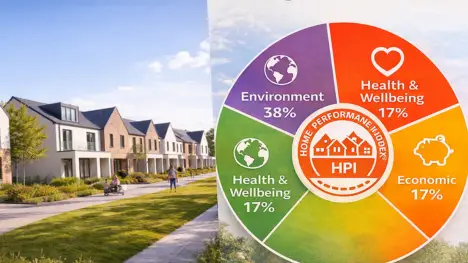

A Building Energy Rating is an official energy efficiency certificate issued by an SEAI-registered assessor. It rates your property on a scale from A1 at most efficient) to G at least efficient), based on the building’s insulation, heating system, ventilation, lighting, and renewable energy sources.
The rating reflects the building itself, not its residents’ habits. Two families in identical homes will receive the same BER regardless of how often they run the heating, because the assessment measures the physical structure and installed systems rather than actual energy consumption. This makes the BER a reliable, standardized comparison tool for buyers, tenants, and lenders.

The BER matters beyond compliance for several concrete reasons. Properties with higher ratings command stronger sale prices and attract better tenants. A BER of B2 or above is the minimum threshold to access the full range of SEAI retrofit grants under the National Retrofit Plan. Under the revised EU Energy Performance of Buildings Directive, minimum energy performance standards are tightening across all member states, and Irish property owners with poor-performing stock face increasing pressure to upgrade. Getting a current BER is the essential first step in understanding where your property stands and what options are available to you.
BUILDING ENERGY RATING Information
A BER Rates Your Home’s Energy Performance on a Scale Between A and G. A-Rated Homes Are the Most Energy Efficient.
It’s Ireland’s official system for measuring a building’s energy efficiency, overseen and managed by the Sustainable Energy Authority of Ireland (SEAI).
The BER rating scale runs from A1 (most efficient) to G (least efficient). A-rated homes are the most energy-efficient and comfortable, often resulting in the lowest energy bills. G-rated homes are the least energy-efficient; they typically require a lot of energy to heat and carry the highest energy bills.
Here’s what the BER scale looks like in plain terms:
A-rated homes are top performers. Low bills, high comfort, often equipped with renewable technologies like heat pumps or solar panels. B-rated homes are very efficient, and the B2 level is the specific target for major retrofits supported by SEAI grants.
C-rated homes are average. Honestly, most Irish homes fall into this category. A significant portion of audited Irish dwellings carry a BER C rating, with many specifically landing at a ber c2 rating. These homes work fine for daily living, but they have real room for improvement. The C2 band sits in the middle of the scale, meaning energy performance is acceptable but not efficient. D, E, F, and G-rated homes tell a harder story. They suffer from serious heat loss, outdated heating systems, and energy bills that punish you every single month
The cost difference is impossible to ignore. For a typical 3-bedroom semi-detached house, a G-rated home could easily have an annual energy bill of over €4,500. A comparable C-rated house might be around €2,000 per year. An A-rated house could have running costs as low as €500. That’s a gap of thousands of euros every single year.
The BER certificate also includes an Energy Performance Indicator (EPI), a numerical value measured in kilowatt-hours per square meter per year (kWh/m²/yr). It’s the number behind the letter, and it tells you precisely how much energy your building theoretically needs annually.
BER Certificate Information
Who Needs a BER Certificate?
A BER certificate in Ireland is compulsory for all homes available for rent or sale, including new buildings that have not been occupied. Property advertisements are legally required to display the BER rating. If you’re browsing listings and that information is missing, ask for it, or flag it with your local building control authority.
In order to receive a government grant payment from SEAI, you must have a BER certificate that proves your home has improved energy efficiency. Your BER isn’t an optional formality; it’s the starting point for everything.
What’s on a BER Rating Certificate?
Your BER cert shows the property’s energy rating (A1-G), the Energy Performance Indicator, and the home’s associated carbon dioxide emissions. It is accompanied by an Advisory Report, a practical document that outlines recommended improvements specific to your property.
The Advisory Report provides recommendations for improving your property’s rating through home improvements. For many homeowners, it’s the clearest energy roadmap they’ll ever receive. Don’t ignore it.
How Long Is a BER Cert Valid?
A BER certificate is valid for up to 10 years, unless the owner makes changes that impact the dwelling’s energy performance, such as a new house extension or a new heating system. When those changes happen, you need a fresh assessment before selling or renting.
You can check whether your property already has a valid cert on the SEAI National BER Register, using your Meter Point Reference Number (MPRN) from your electricity bill or an existing BER number.
Are Any Buildings Exempt?
Yes, not every property needs one. The main exemptions include protected structures and national monuments, places of worship, and stand-alone buildings with a total floor area of less than 50 square meters. Industrial buildings not designed for human occupancy with a low installed heat capacity are also generally exempt
Calculations and Methodology
A BER rating is calculated by a SEAI-registered BER assessor who surveys your property and inputs the data into approved BER software.How does a letter like “B2” or “D1” actually get assigned to a building? There’s a rigorous technical process behind every BER rating Calculator. Two separate methodologies exist depending on whether it’s a home or a commercial property.
DEAP
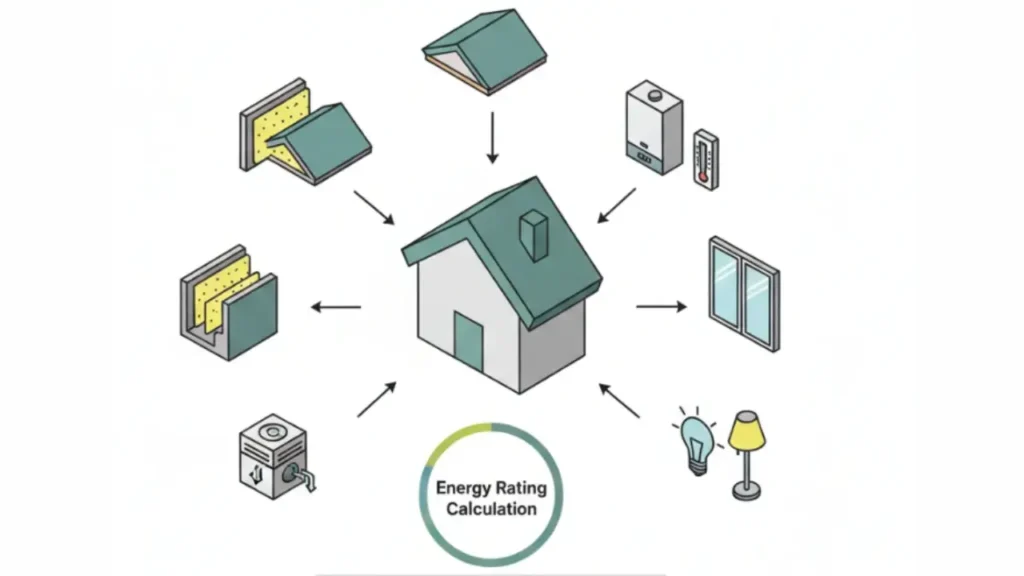
For residential buildings, the calculation method is called DEAP (Dwelling Energy Assessment Procedure). DEAP is the official procedure for calculating the energy performance of dwellings in Ireland for the production of Building Energy Ratings (BERs).
DEAP was built specifically for the Irish context. The software takes into account the Irish climate, construction types, heating systems, and occupancy patterns, and calculates the annual energy use for heating, lighting, and ventilating the property.
One thing worth understanding clearly is that the BER energy rating is based on the building itself, its fabric and installed systems, and is not an operational rating based on the energy consumption of the occupants. DEAP doesn’t measure how you personally use your home. It works on standardized assumptions, so any two properties can be compared fairly, regardless of who lives in them.
The DEAP workbook is a BER calculator in Microsoft Excel format, allowing users to view all the calculation formulas used in the DEAP software. It’s available on the SEAI website, though only registered BER assessors can officially publish a BER certificate through the system.
NEAP
For commercial and non-residential buildings, the methodology is NEAP (Non-Domestic Energy Assessment Procedure). NEAP is Ireland’s official methodology for calculating a BER for non-domestic buildings. The NEAP software calculates a building’s energy consumption and carbon dioxide emissions, accounting for space heating and cooling, water heating, ventilation, and lighting.
This is where Commercial BER assessments come in. Any non-domestic building sold, rented, or newly built must have a BER issued through NEAP. NEAP is also used to generate the BER and advisory report for new and existing non-domestic buildings. Energy consumption is expressed as kilowatt-hours per square meter of floor area per year, and CO₂ emissions are expressed in kilograms per square meter per year.
At BES Consultants, our engineers specialize in Commercial BER assessments using NEAP and advanced modeling tools, including IES-VE. Whether you’re managing a retail unit in Dublin, an office block in Kildare, or an industrial warehouse anywhere in Ireland, we deliver accurate, compliant, and commercially useful results. Get in touch with our team today to discuss your commercial property needs.
Life-Cycle Global Warming Potential (GWP)
This is where things get genuinely forward-looking and where smart property owners and developers need to start paying attention now.
The 2024 recast of the EU Energy Performance of Buildings Directive (EPBD) introduced a major new requirement: Life-Cycle Global Warming Potential (GWP). It goes beyond measuring operational energy and asks a much bigger question: What is the total carbon impact of a building across its entire lifespan?
The GWP will include both operational and embodied carbon emissions over the building’s 50-year life cycle. To fulfill this requirement, Ireland must develop an embodied carbon database and methodology tools to determine the full embodied carbon of building materials across construction, use, renovation, and demolition.
The timelines are already set. The EPBD requires that the life-cycle GWP be included in the Building Energy Rating from January 2028 for all new buildings with a useful floor area larger than 1,000 m², as set by the Sustainable Energy Authority of Ireland, with the requirement extending to all new buildings by 2030. Under Ireland’s Climate Action Plan, SEAI is tasked with finalizing both the methodology and the embodied carbon database by September 2025.
For building designers, developers, and commercial clients, this is a shift worth preparing for now, not scrambling to meet at the last minute. BES Consultants stays ahead of these regulatory changes so our clients don’t get caught off guard. Contact us to understand how Life-Cycle GWP will affect your next project.
Display Energy Certificate
A Display Energy Certificate (DEC) is different from a standard BER certificate. While a BER is based on the theoretical energy performance of a building, a DEC measures actual energy consumption based on real meter readings over a 12-month period.
DECs are required for large public buildings that are frequently visited by the public. They must be prominently displayed on the premises, which is exactly why they’re called display certificates. You must register with SEAI to carry out both BER and Display Energy Certificate (DEC) assessments.
BES Consultants is registered to carry out DEC assessments across Ireland. If your building requires a DEC, our team handles the full process from data collection to certificate publication. Reach out to us at info@besconsultants.ie to get started.
Home Heating Appliance Register
The HARP database, Home Appliance Register of Products, is a product efficiency database maintained specifically for Ireland. The HARP database is a product efficiency database for home heating appliances in Ireland.
BER assessors use HARP to source specific efficiency data for boilers, heat pumps, and other heating appliances when completing assessments. If a product appears in HARP, those figures take priority over default values in DEAP software, which typically results in a more accurate and often more favorable rating for the property owner.
Registered BER Assessors
You can’t get a BER certificate from just anyone. Only a registered BER assessor, someone who has completed approved training and is listed on the SEAI National Register, can legally publish a BER certificate in Ireland.

Domestic BER Assessors
For Domestic BER assessments, the assessor visits your home and carries out a thorough physical survey. The inspection normally takes between 30 minutes and 1 hour, depending on the size of your home. The assessor completes a survey of each room, including the attic and garage, and takes photographs of different areas as part of the assessment.
They examine insulation in walls, attics, and floors; the type and condition of windows and doors; the heating system and its controls; ventilation; and fixed lighting. After the visit, all data is entered into the DEAP software, and the certificate is published.
Commercial BER Assessors
For Commercial BER assessments, the process is more technically involved. Non-domestic assessors use NEAP and approved modeling software to produce ratings for offices, retail units, schools, hotels, warehouses, and mixed-use properties.
This is exactly where BES Consultants stands apart. Our team brings together engineering expertise, building physics knowledge, and hands-on experience with complex commercial properties across Ireland. We don’t just tick boxes, we deliver assessments that are accurate, commercially useful, and fully compliant with Part L of the Building Regulations.
How to Find a BER Assessor
To find a BER assessor in your area, you can search the SEAI National Register of BER Assessors at seai.ie. The register is searchable by location and covers all currently registered domestic and non-domestic assessors across Ireland.
There is no cap on the number of BER assessors operating in Ireland, which is good news for property owners, as it means genuine choice in the market. But not all assessors bring the same level of expertise, especially when it comes to commercial properties.
If you’re looking for a BER assessor you can actually rely on for domestic or commercial properties anywhere in Ireland, BES Consultants is ready to help. Contact us to arrange your assessment.
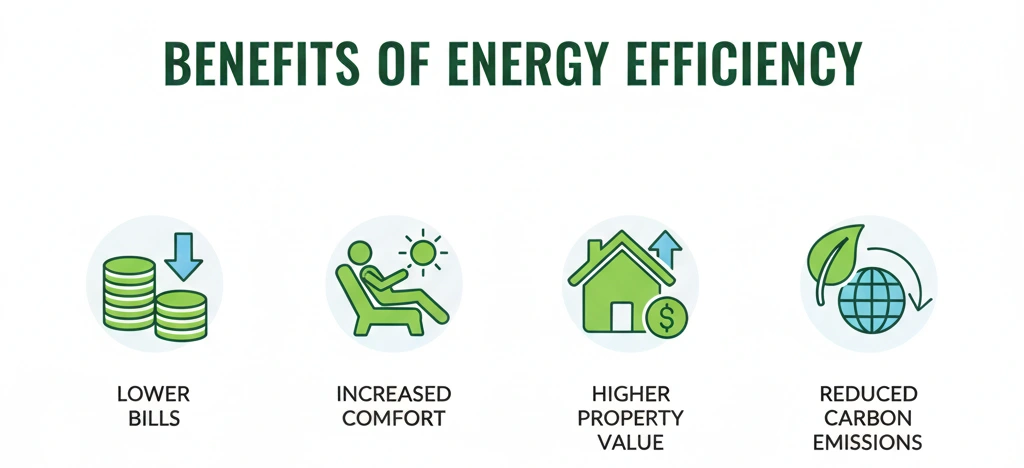
Improving your Building Energy Rating is one of the most effective ways to lower your annual energy costs and reduce the carbon emissions of your home. Making a range of energy-efficiency improvements can greatly enhance your property’s overall performance, helping to create a warmer, more comfortable, and more cost-efficient living environment. A home with a better BER rating not only uses less energy, but can also contribute to improved health and wellbeing by providing more consistent indoor comfort throughout the year
1. Improve Insulation
Upgrading attic, wall, or floor insulation significantly reduces heat loss and improves comfort.
2. Install an Efficient Heating System
Replacing old boilers with high-efficiency boilers or heat pumps can dramatically improve your BER.
3. Install Smart Heating Controls
Zoned heating, programmable thermostats, and smart controls reduce wasted energy.
4. Upgrade Windows and Doors
Double or triple glazing, along with proper sealing, reduces drafts and heat loss.
5. Switch to LED Lighting
Energy-efficient LED lighting lowers your calculated lighting energy demand.
Many of these upgrades may qualify for SEAI grants, making improvements more affordable.
Common Misconceptions About BER
“A BER shows my actual energy usage.”
- BER only measures electricity consumption, while in reality it evaluates the overall energy performance of a building including heating, cooling, ventilation, lighting, and hot water systems.
- A high BER automatically means low energy bills, but actual energy costs also depend on occupants’ behavior and energy usage patterns.
- Older buildings cannot achieve good BER ratings, even though renovations like insulation, efficient windows, and modern heating systems can significantly improve their rating.
- BER is only important when selling a property, whereas it is also useful for renting, renovation planning, and improving energy efficiency.
- BER shows the exact energy consumption of a building, but it actually represents estimated or theoretical energy performance based on standard assumptions.
- A high BER means the building is completely environmentally sustainable, even though the rating mainly focuses on energy efficiency and not other sustainability factors.
- Once a building receives a BER, the rating never changes, while in reality it can change after renovations, system upgrades, or reassessments.
Frequently Asked Questions About BER
How long is a BER certificate valid in Ireland?
A BER certificate is valid for 10 years, provided no major energy-related changes are made to the property.
Can I check a BER rating online?
Yes. Existing valid BER certificates can be searched on the SEAI National BER Register.
How Much Does a BER Assessment Cost in Ireland?
The cost of a Building Energy Rating (BER) assessment in Ireland can vary depending on several factors, including property size, type, location, and complexity.
Is the Cost of a BER Worth It?
For most homeowners, the answer is yes.
A BER assessment can:
- Help lower energy bills through targeted improvements
- Increase property value and marketability
- Be legally required when selling or renting
- Support eligibility for SEAI grants
- Enable access to green mortgage rates with lower interest costs
Considering a BER certificate is valid for 10 years, the one-off cost is relatively small compared to the long-term financial benefits.
What is a good BER rating for a house?
For houses BER rating of Grade A or B is considered very good. These homes are energy-efficient, comfortable, and cheaper to run.
Is a C2 BER rating good?
A C2 rating is considered average. While not inefficient, improvements to insulation or heating could significantly reduce energy costs.
Which is better, an A or G BER rating?
An A-rated home is vastly more efficient than a G-rated home. G-rated properties typically require extensive upgrades and have high energy bills.
What does Class A energy mean?
Class A (A1–A3) BER represents the highest level of energy efficiency, with low energy use, modern systems, and minimal environmental impact.
Conclusion
A Building Energy Rating is a reflection of a property. It’s a direct reflection of how much your property costs to run, how comfortable it is to live or work in, and how ready it is for Ireland’s increasingly strict energy regulations.
Whether you’re a homeowner looking to sell, a landlord keeping your rental legally compliant, or a developer planning a new commercial build, understanding your BER is the smartest first step you can take.
At BES Consultants, we’ve helped homeowners, architects, developers, and commercial clients across Ireland navigate every aspect of building energy performance from Domestic BER and Commercial BER assessments to NZEB compliance, Display Energy Certificates, Energy Audits, and beyond. Our team is SEAI-registered, technically rigorous, and genuinely committed to delivering the most accurate and useful results possible.
Read More on SEAI
Have a look at our SERVICES.
Ready to Improve Your BER?
Arrange a BER assessment with a SEAI certified BER assessor in Ireland to understand your current rating and identify cost-effective improvements. Better energy efficiency means better savings, comfort, and sustainability — and now you have the knowledge to make it happen.