
Buying or developing a new home today involves much more than checking appearance or energy ratings. Modern housing is expected to be energy efficient, comfortable, healthy, durable, and environmentally responsible. The Home Performance Index (HPI) is Ireland’s leading certification system designed to help deliver sustainable new homes and residential developments.
It provides an independent framework for assessing whether homes meet high standards of environmental performance, health and wellbeing, construction quality, and long-term sustainability.
As demand for green homes in Ireland continues to grow, developers, investors, and homebuyers are increasingly looking for reliable ways to identify housing that goes beyond minimum regulatory requirements. The Home Performance Index helps meet this need by evaluating multiple aspects of housing performance through a structured certification system.
What Is the Home Performance Index?
The Home Performance Index (HPI) is a voluntary sustainability certification system for new homes in Ireland. It evaluates residential developments using more than 30 indicators that assess environmental, social, and economic performance.
Unlike traditional assessments that focus mainly on energy efficiency, HPI takes a holistic approach to housing performance. The framework looks at how a home performs in several key areas, including:
- environmental sustainability
- indoor air quality and occupant health
- water efficiency and responsible resource use
- construction quality and verification
- long-term running costs
- accessibility and adaptability
- access to services and transport
In simple terms, the Home Performance Index helps answer an important question:
Is this new home designed and built to perform well for both people and the environment?
Developments that meet the required standards receive certification as HPI or Gold HPI.
Who Created the Home Performance Index?
The Home Performance Index was launched in 2016 by the Irish Green Building Council (IGBC).
The Irish Green Building Council is a non-profit organization founded in 2011 that promotes sustainable construction and environmental leadership within Ireland’s built environment. Its members include organisations across the construction and property sectors such as:
- architects and engineers
- construction companies and contractors
- property developers
- universities and research institutions
- energy specialists
- local authorities
- environmental organisations
This collaborative network helped ensure that HPI reflects Irish housing needs, building regulations, and sustainability priorities, while drawing on international best practice in green building certification.
Why the Home Performance Index Matters for Sustainable Housing in Ireland
Ireland has placed increasing emphasis on climate action and sustainable development in recent years. As expectations rise, buyers and renters are looking for homes that deliver more than basic regulatory compliance.
Many people now prioritise homes that provide:
- lower energy bills
- improved indoor air quality and comfort
- reduced environmental impact
- strong construction quality
- long-term affordability
The Home Performance Index supports the delivery of sustainable housing in Ireland by encouraging project teams to consider environmental, social, and economic factors throughout the design and construction process.
By providing a recognized certification framework, HPI helps developers create green homes in Ireland that meet higher standards of performance.

Home Performance Index vs BER Rating
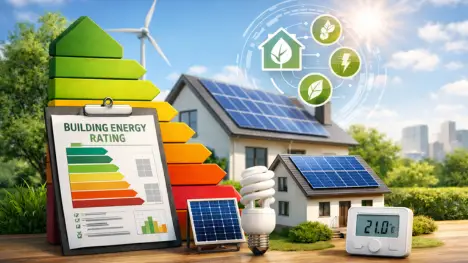
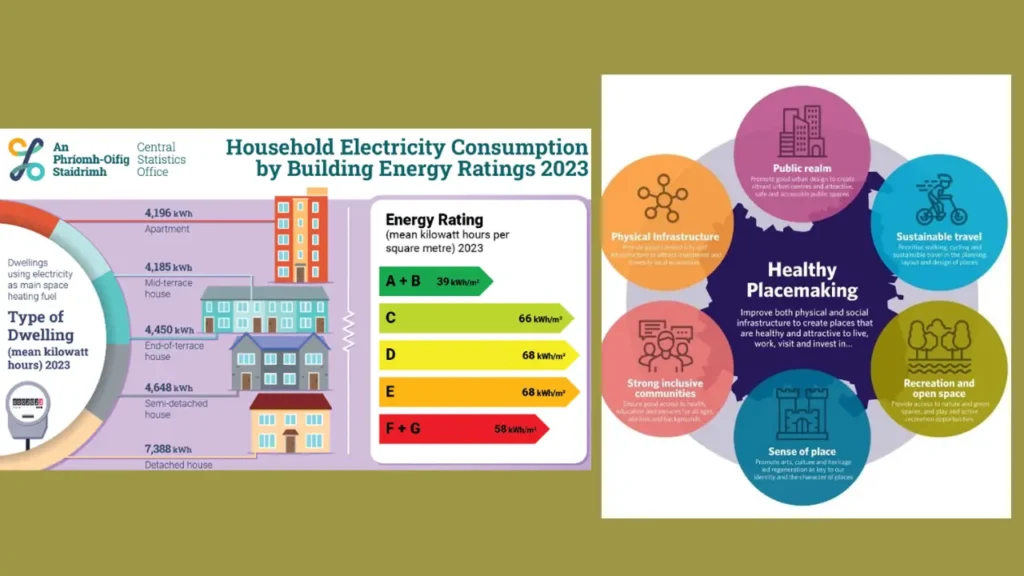
In Ireland, every home must have a Building Energy Rating (BER) certificate. BER ratings measure the energy efficiency of a building, focusing mainly on energy consumption and carbon emissions.
However, BER does not assess many other aspects of housing quality.
The Home Performance Index complements BER by evaluating a much broader range of sustainability and performance factors.
| Feature | BER Rating | Home Performance Index |
| Main focus | Energy efficiency | Overall sustainability and housing quality |
| Measures | Energy use and CO₂ emissions | Environment, health, economics, quality and location |
| Mandatory | Yes | No (voluntary certification) |
| Scope | Energy performance only | More than 30 sustainability indicators |
| Certification levels | A–G rating | HPI or Gold HPI |
In simple terms:
- BER measures how energy efficient a home is.
- HPI evaluates the overall sustainability and quality of the home and its location.
Together, these systems provide a more complete picture of housing performance.
How HPI Certification Works
HPI certification is based on more than 30 measurable indicators across several sustainability categories.
The system combines:
- mandatory indicators that every project must meet
- voluntary indicators that allow developments to achieve higher scores
Typically, the framework includes:
- 12 mandatory indicators
- 25 voluntary indicators
Applicants must submit verified documentation and evidence before points can be awarded.
Examples of mandatory performance areas include:
- ventilation and indoor air quality
- water efficiency
- building testing and verification
- airtightness and thermal performance
Projects must meet both mandatory requirements and minimum scoring thresholds in order to receive certification.
Five Categories of the Home Performance Index
The Home Performance Index evaluates homes across five key sustainability categories, each addressing a different aspect of long-term housing performance.
1. Environment
This category assesses the environmental footprint of the development, including energy use, carbon emissions, water consumption, construction materials, biodiversity protection, and land use.
2. Health and Wellbeing
This category focuses on factors that influence everyday living conditions such as indoor air quality, ventilation, daylight levels, acoustic comfort, and walkability.
3. Economics
The economics category considers the financial performance of the home over time, including running costs, transport costs, and long-term value.
4. Quality Assurance
This category evaluates the quality of the design and construction process, including project team expertise, testing, and verification.
5. Sustainable Location
This category assesses access to services, public transport, amenities, and environmental risks such as flooding.
HPI Category Weightings
Each category contributes a percentage to the overall HPI score.
- Environment — 38%
- Health & Wellbeing — 17%
- Economics — 13%
- Quality Assurance — 17%
- Sustainable Location — 15%
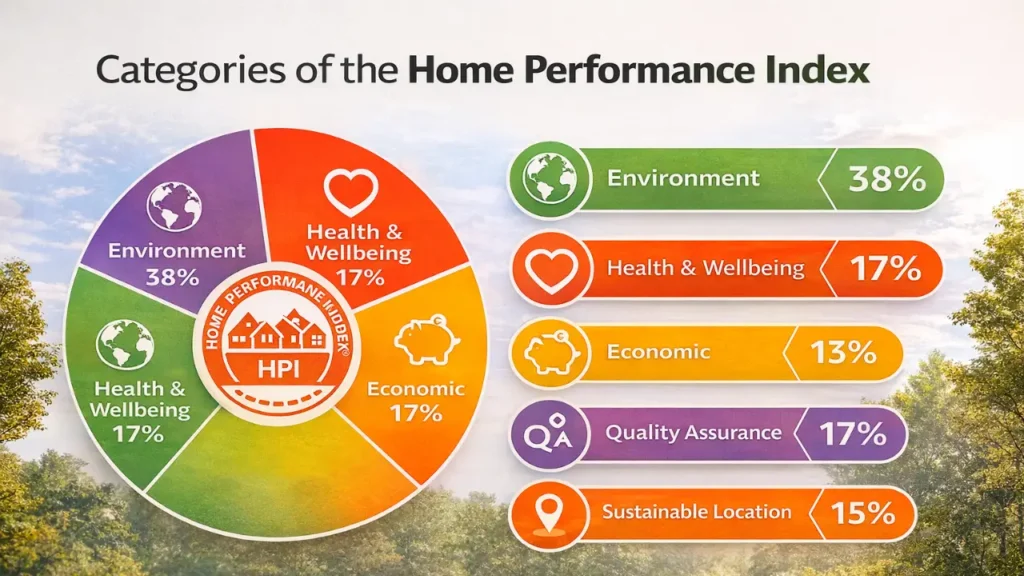
Environmental performance carries the largest weighting, reflecting the importance of reducing the environmental impact of housing developments.
What the Home Performance Index Measures
The Home Performance Index evaluates a wide range of sustainability indicators relevant to modern housing.
These include:
- energy efficiency
- carbon emissions
- indoor air quality
- ventilation performance
- VOC levels
- radon risk management
- water efficiency and water quality
- daylight levels
- acoustic comfort
- embodied carbon in materials
- biodiversity protection
- universal design and accessibility
- lifetime adaptability
- transport connectivity
- access to amenities
- life-cycle assessment
- circular economy principles
- design for durability and reuse
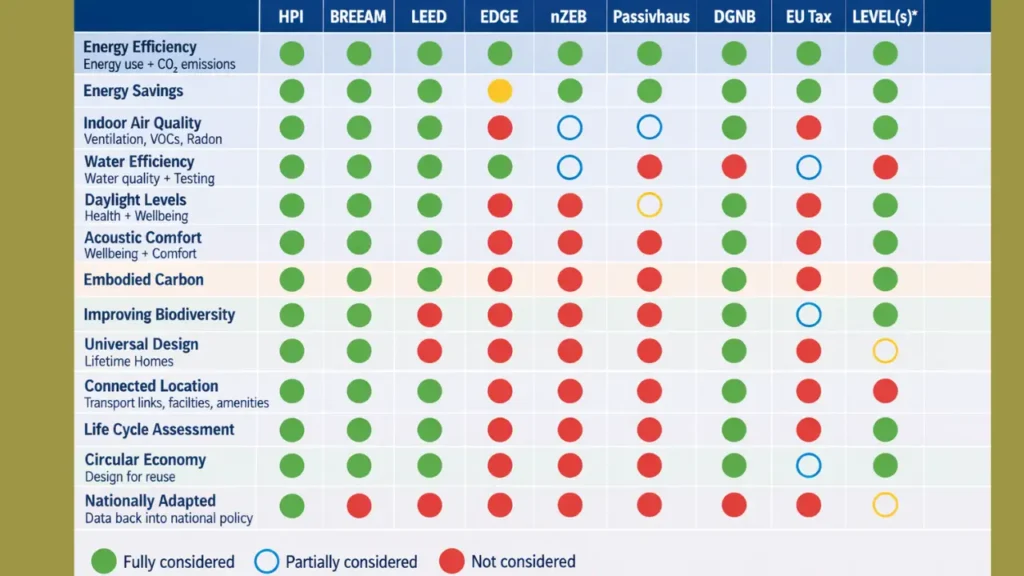
Together these indicators provide a comprehensive framework for sustainable residential development
HPI and Green Finance
The Home Performance Index can also support green finance initiatives and sustainable investment in housing.
The framework aligns with principles found in EU Level(s) framework and can assist organisations reporting against the EU Sustainable Finance Taxonomy.
For financial institutions and investors, this provides a credible way to identify residential developments that meet recognised sustainability criteria.
HPI Certification Levels
Developments that meet the requirements receive one of two certification ratings:
HPI
or
Gold HPI
Gold certification represents a higher level of sustainability performance across the HPI assessment categories.
To achieve certification, projects must meet:
- mandatory indicator requirements
- minimum scoring thresholds
- independent verification procedures
Why Developers Use HPI Certification
Many property developers in Ireland use HPI certification as a framework for delivering sustainable residential developments.
Benefits include:
- independent sustainability verification
- stronger credibility with buyers and investors
- structured guidance for design teams
- improved market differentiation
Certification demonstrates that a project has been assessed against recognised sustainability benchmarks.
Why HPI Matters for Homebuyers and Renters
For buyers and renters, HPI certification provides confidence that a home has been designed to perform well in everyday living.
Homes developed under the HPI framework aim to deliver:
- improved indoor air quality
- better daylight and thermal comfort
- reduced energy and water consumption
- lower running costs
- strong construction quality
- access to well-connected communities
This broader evaluation helps buyers compare homes based on overall quality and sustainability, not just energy ratings.
FAQs
Is Home Performance Index mandatory in Ireland?
No. The Home Performance Index is a voluntary certification system. However, many developers choose to adopt it to demonstrate higher sustainability and construction standards.
What does HPI stand for?
HPI stands for Home Performance Index, a sustainability certification developed by the Irish Green Building Council for residential developments.
What is HPI Gold?
HPI Gold is the higher certification level within the Home Performance Index framework and indicates stronger sustainability performance.
Does HPI replace BER ratings?
No. BER certificates are legally required in Ireland and measure energy efficiency. HPI is an additional voluntary certification that evaluates broader sustainability and housing quality factors.
Final Thoughts
The Home Performance Index (HPI) provides a comprehensive framework for evaluating sustainable new homes in Ireland.
Developed by the Irish Green Building Council (IGBC), the certification system assesses housing across environmental performance, health and wellbeing, economic value, construction quality, and sustainable location.
By combining these factors into one structured framework, HPI helps support the delivery of better homes, healthier communities, and more sustainable residential development in Ireland.
For developers, it offers a clear pathway to delivering higher-quality housing.
For investors, it provides credible sustainability verification.
For buyers and residents, it offers greater confidence that a home has been designed and built to perform well over the long term.
If you are planning an HPI-certified project and need expert guidance, you can contact BES Consultants for professional Home Performance Index assessment and support.